
A Ministry That Lives Up to the Words
I've had enough interactions with well-meaning organizations that neatly portray themselves from flattering angles to have a bit of what some may call “healthy skepticism.” As I’ve learned about Hope Alive! over the last few years, I couldn’t help but occasionally ask myself, “What’s the catch?” and “Do they really?” As I got on the plane to Uganda, I was filled with excitement and anticipation, but quietly wondering if I might discover the less-than-flattering, the overstatements, and the hyperbole alongside the good, beautiful, and helpful. So as I boarded the plane for my first visit to Hope Alive!’s sites in Uganda, I felt a mixture of excitement and apprehension. I’ve heard so many great things about Hope Alive! – but would they, could they live up to all the great things I’ve heard?
In a word, YES! And then some! What I found stunned me and left me profoundly thankful to be connected to the beautiful people of Uganda and the deeply impactful ministry of Hope Alive!
Hope Alive! is so much more than can ever be captured in a single story. It is changing families for the better, and in so many more ways than I imagined. For example, I knew we had a demonstration farm in Gulu, but nothing compared with seeing it with my own eyes.. It is so much more than I imagined, and it is all available to help families and improve their farming efforts. There are seedlings for families to take home and plant, full-grown trees with fruit ripe for picking, and even a fish farm. There are fields comparing the “Farming God’s Way” cultivation method with the local way of farming. Surrounding those fields are soil-enriching plants that can be used for mulch, so the farms are self-sustaining. The crop side of the farm alone is a lot to take in. But beyond that, the farm also raises many kinds of animals to help families. It is really hard to capture all the good this one piece of property is doing for the surrounding community. So much of Hope Alive! is just like that farm – easy to understand on the surface but so much more difficult to comprehend the depth of what it means for those who are a part of it.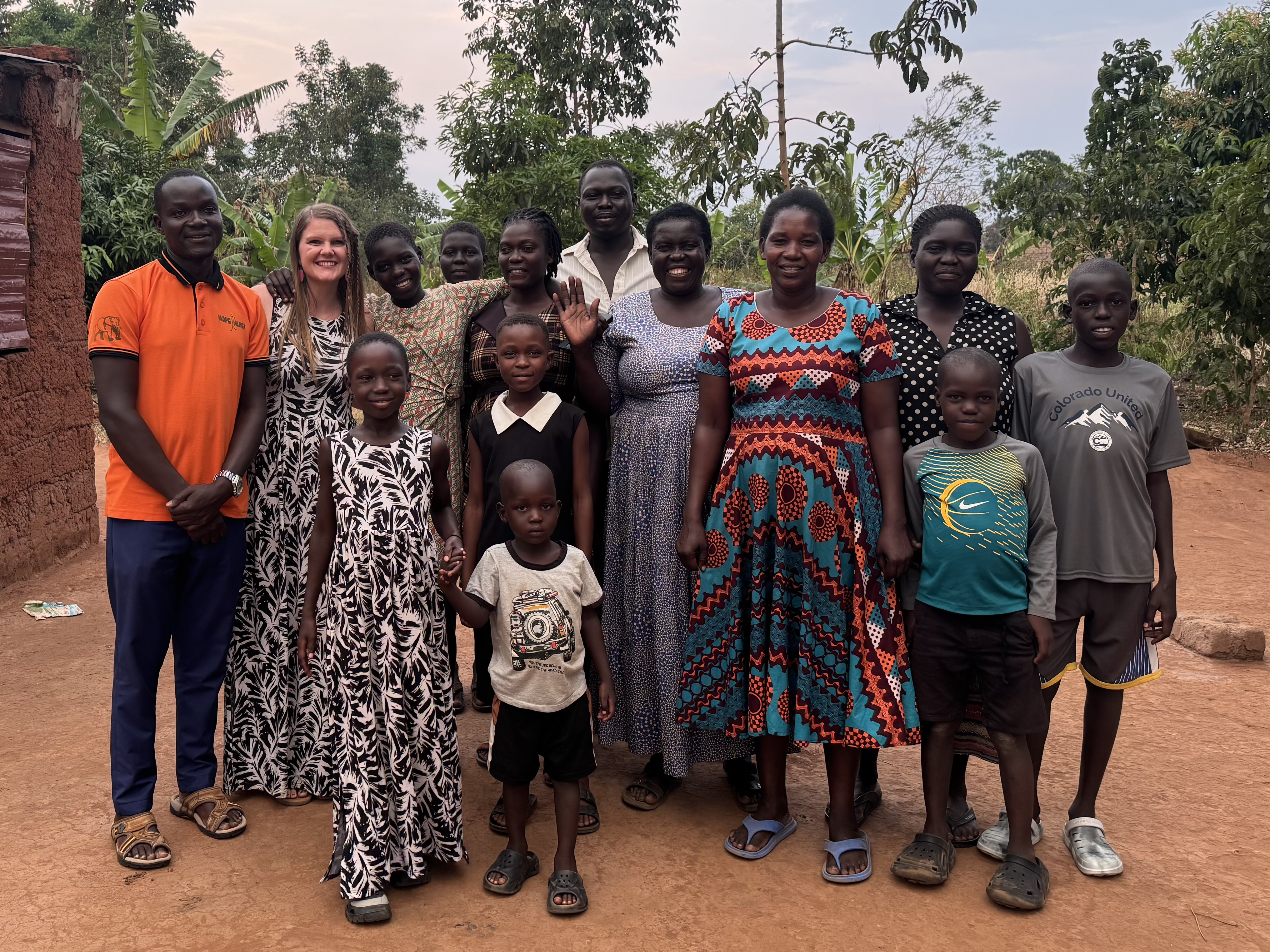
During my two-week trip, I heard from so many students that their lives drastically changed when Hope Alive! enrolled them. I met graduate after graduate who emphasized that they could never have gotten to where they are without Hope Alive! Several told me how excited they are to give back to current students. I saw the incredible opportunities HA! provides not just for students but for their families. And I witnessed the deep care each staff member and mentor has for students. It was overwhelming, incredibly beautiful, and such a clear picture of God’s love.
Something I really enjoyed experiencing was the deep gratitude families have for Hope Alive! There is so much respect for the organization and genuine honor given to those who represent it. This was especially evident when I visited the home of the student I sponsor. The entire extended family welcomed us and sang the praises of Hope Alive!
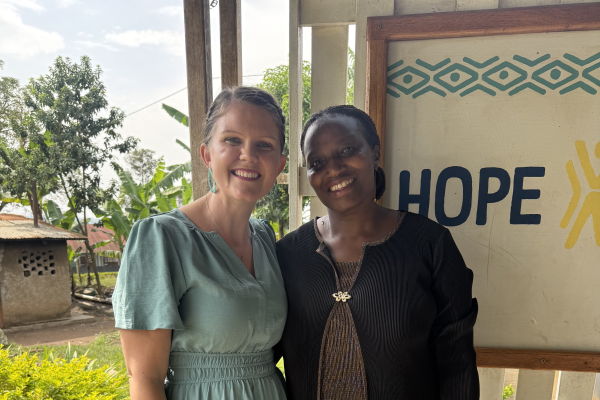
I also got the chance to meet the staff of Hope Alive!. Man, are these students in good hands. Each staff member brings something different to the table, but they all share a deep love for these students and their growth. Their humility is so apparent.
One of the things I loved most about Uganda was the warm welcome I received everywhere I went. The Ugandan handshake is something special. The three-minute greeting, the intentional welcoming of someone into your space, is something I could surely get used to. What a beautiful picture of how we are meant to greet one another in Christ. It felt like the openings of Paul’s letters to his churches coming to life.
I really enjoyed learning how different each site is. Hope Alive! now has five sites, and each one has a completely distinct feel, shaped by leadership, location, and the local culture.
In the north are the Koro and Koch Lii sites. These areas were deeply affected by northern Uganda’s 1998-2006 civil war, and the culture feels heavy and hard in some ways. They tend to be more formal and traditional. Unlike the rest of Uganda, they speak Acholi. The heat was dry and the sun was bright. And yet, the affection for each other and visitors was still there.
About six hours south is the Kampala site. Most of the students are older, junior high and above. This is the capital city, so the students’ English is strong, and their humor is quick. This group feels urban and energetic, and also like everyone they meet is already family.
Several hours south of Kampala are the Masaka and Kyabakuza sites. The air there was cooler with more humidity. It rained several times while we were there, even in the dry season. The people feel freer. It is less formal, with warmth expressed more openly.
This trip gave me a much richer picture of Hope Alive! and how it is actually transforming communities. The needs in Uganda are vast and, at times, overwhelming. But as Caleb said at the beginning of our trip, Hope Alive! is about depth, not breadth. It is not about engaging the most people possible. It is about walking closely and intentionally with students and families over extended periods of time. The students and their families are truly being transformed through their walks withJesus, and that kind of transformation has a ripple effect far beyond what can be measured. I am so grateful I got to see it with my own eyes.