MENU
Progress Report Hope Alive! Land Ladjwatek
Ladjwatek is in the northern part of Uganda, not far from the town of Gulu.
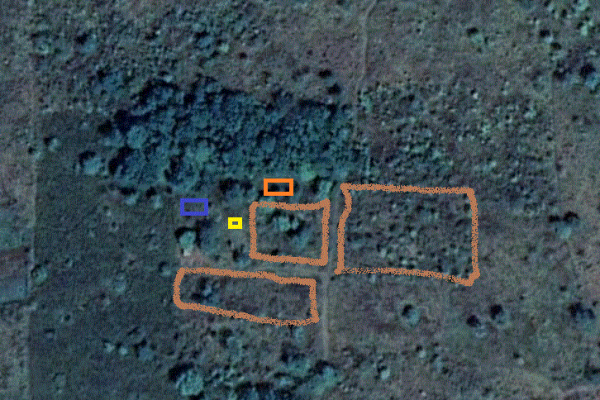
Map legend: House is blue, Piggery is Orange, Cricket house is Yellow, crops are brown.
Initially the plan was to wait until all the trees in Koch Lii were planted, but because of another lockdown all older HA! students were home and available to help so we decided to start it earlier than planned. This has been a good way to support the students and local community by providing employment during the lockdown.
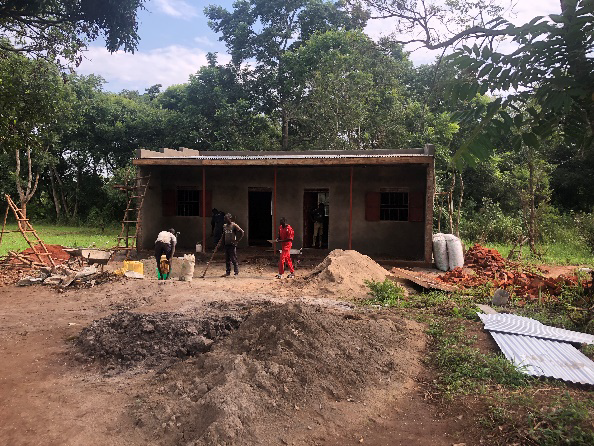
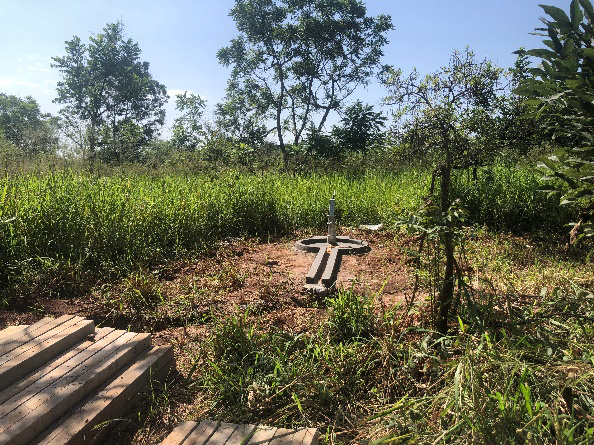
In order to make it possible to live and work on the land we built a two-room house (dried grass used for roofing huts is not available in the middle of wet season), a pit latrine, and dug a well. Ojok Christopher, an HA! student, was in charge of the construction (supported by five other HA! students), while WET Consulting (https://www.bmsworldmission.org/wet-consulting) dug the well.
Odokonyero Brian, one of the three interns, got stuck in Gulu as he had been sick right before the lockdown and was in Gulu for medical treatment while the lockdown was imposed. Since he wasn’t able to return it worked out for him to be in charge of all agricultural projects in Ladjwatek.
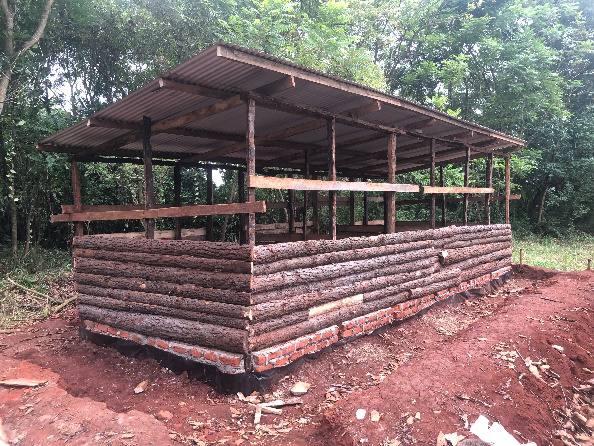
As the house and pit latrine were nearing completion the construction of a piggery started. Pigs were chosen to start with for several reasons. Pigs are relatively easy to keep and if fed properly can be quite profitable. Five participants in the first round of microloans chose to keep pigs, but the results have varied, because of a lack of knowledge of how to raise pigs well. In the future we will offer a short training to anyone who chooses to start keeping pigs. This will include an intro to biosecurity (keeping the area contained from contamination in order to prevent the swine flu), which is a major threat to small scale farmers in the region. A majority of the loan participants have struggled repaying their loans in a timely manner. It’s hard to find reliable customers if you do not have a steady supply of pigs and it has been a struggle to get actual payments after pigs have been sold. Finally using the money for repayments is hard, since there are many demands for that money. As a result, we decided that having an HA! piggery will make it much easier for the participants to make repayments. Instead of cash payments they will repay in piglets and the value of the piglets will be deducted from their loan balance. Several participants in the second microloan round have already indicated that they would like to keep pigs. Instead of handing out loan money we will provide the participants with piglets from our own piggery. Since we can monitor the pigs on a daily basis, we can be more confident that participants receive healthy piglets compared to trying to find piglets somewhere locally.
For the piggery we’ve decided to use deep-litter housing. This method is not well known or used in Uganda, but provides several benefits for the pigs as well as the owners. Instead of concrete floors pigs live on a one-meter-deep natural floor consisting of branches, leaves, rice husks and peanut shells (all waste products that are locally available). The floor has been sprayed with a home-made IMO (Indigenous Microorganisms), which reduces bad odors from animal waste and creates high quality compost. Once a year the compost can be removed and used to fertilize the farm land.
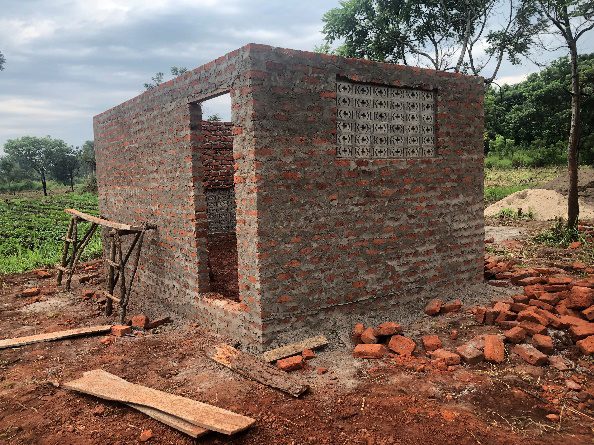
After the construction of the piggery the construction of a small cricket house has started. Crickets are an excellent source of protein, but have a much smaller carbon footprint compared to other protein sources. Cricket rearing can significantly reduce malnutrition in children and can also provide an alternative source of income for small farmers. Flying Food (https://www.flyingfoodproject.com) will assist in the training and will be available for consulting as we start this project. They have started up a pilot project in Masaka in 2013. If we are able to successfully raise crickets in the North as well, we will organize a training for HA! families and give them an opportunity to start raising crickets. As soon as the lockdown lifts, we will be able to get cricket eggs and a trainer from Masaka to come up to Gulu to get the project started.
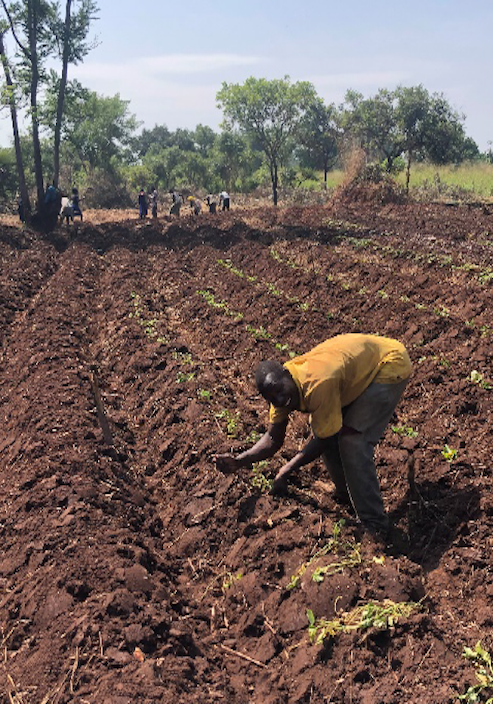
While the construction took place Brian simultaneously planted several gardens to grow food for the pigs and crickets. We currently have a field of sweet potatoes, a field of soya, and 50 moringa trees. Corn, pumpkin, sunflowers and amaranth will be planted in July and August.
Future projects could include the construction of a granary, tilapia ponds, ducks, broilers, as well as acquiring a grinding machine. We will also potentially use one acre to plant trees for charcoal with intercropping, so HA! families can see it first hand during the training next year when we will invite them to join the charcoal project.
Map legend: House is blue, Piggery is Orange, Cricket house is Yellow, crops are brown.
Initially the plan was to wait until all the trees in Koch Lii were planted, but because of another lockdown all older HA! students were home and available to help so we decided to start it earlier than planned. This has been a good way to support the students and local community by providing employment during the lockdown.
In order to make it possible to live and work on the land we built a two-room house (dried grass used for roofing huts is not available in the middle of wet season), a pit latrine, and dug a well. Ojok Christopher, an HA! student, was in charge of the construction (supported by five other HA! students), while WET Consulting (https://www.bmsworldmission.org/wet-consulting) dug the well.
Odokonyero Brian, one of the three interns, got stuck in Gulu as he had been sick right before the lockdown and was in Gulu for medical treatment while the lockdown was imposed. Since he wasn’t able to return it worked out for him to be in charge of all agricultural projects in Ladjwatek.
As the house and pit latrine were nearing completion the construction of a piggery started. Pigs were chosen to start with for several reasons. Pigs are relatively easy to keep and if fed properly can be quite profitable. Five participants in the first round of microloans chose to keep pigs, but the results have varied, because of a lack of knowledge of how to raise pigs well. In the future we will offer a short training to anyone who chooses to start keeping pigs. This will include an intro to biosecurity (keeping the area contained from contamination in order to prevent the swine flu), which is a major threat to small scale farmers in the region. A majority of the loan participants have struggled repaying their loans in a timely manner. It’s hard to find reliable customers if you do not have a steady supply of pigs and it has been a struggle to get actual payments after pigs have been sold. Finally using the money for repayments is hard, since there are many demands for that money. As a result, we decided that having an HA! piggery will make it much easier for the participants to make repayments. Instead of cash payments they will repay in piglets and the value of the piglets will be deducted from their loan balance. Several participants in the second microloan round have already indicated that they would like to keep pigs. Instead of handing out loan money we will provide the participants with piglets from our own piggery. Since we can monitor the pigs on a daily basis, we can be more confident that participants receive healthy piglets compared to trying to find piglets somewhere locally.
For the piggery we’ve decided to use deep-litter housing. This method is not well known or used in Uganda, but provides several benefits for the pigs as well as the owners. Instead of concrete floors pigs live on a one-meter-deep natural floor consisting of branches, leaves, rice husks and peanut shells (all waste products that are locally available). The floor has been sprayed with a home-made IMO (Indigenous Microorganisms), which reduces bad odors from animal waste and creates high quality compost. Once a year the compost can be removed and used to fertilize the farm land.
After the construction of the piggery the construction of a small cricket house has started. Crickets are an excellent source of protein, but have a much smaller carbon footprint compared to other protein sources. Cricket rearing can significantly reduce malnutrition in children and can also provide an alternative source of income for small farmers. Flying Food (https://www.flyingfoodproject.com) will assist in the training and will be available for consulting as we start this project. They have started up a pilot project in Masaka in 2013. If we are able to successfully raise crickets in the North as well, we will organize a training for HA! families and give them an opportunity to start raising crickets. As soon as the lockdown lifts, we will be able to get cricket eggs and a trainer from Masaka to come up to Gulu to get the project started.
While the construction took place Brian simultaneously planted several gardens to grow food for the pigs and crickets. We currently have a field of sweet potatoes, a field of soya, and 50 moringa trees. Corn, pumpkin, sunflowers and amaranth will be planted in July and August.
Future projects could include the construction of a granary, tilapia ponds, ducks, broilers, as well as acquiring a grinding machine. We will also potentially use one acre to plant trees for charcoal with intercropping, so HA! families can see it first hand during the training next year when we will invite them to join the charcoal project.
Fragile Families Flourishing in the Hope of Jesus!

Stay in the Loop
Sign up to receive our Hope Alive! email newsletters